Use fixed rules when the valid steps and conditions can be specified in advance. Add an AI step when interpretation is useful but the surrounding process should remain predictable. Consider an agent when the next action genuinely depends on what it discovers, and you can still bound and verify its work.
This is a task-selection reference for business owners, reviewed September 14, 2026. The eight examples below are proposed design choices, not findings from a deployment study. They help identify where autonomy adds value and where it merely introduces another source of uncertainty.
- 01Interpretation does not require full autonomy.A model can classify or draft inside an otherwise fixed process.
- 02Uncertainty must justify the added freedom.An agent is useful when it needs to discover the next step, not just follow a known sequence.
- 03Choose the acceptance check early.If the result cannot be verified, a more autonomous system may make the business risk harder to manage.
01 — Practical guidanceThree forms of automation that are often confused
In a rules-only process, software follows explicit conditions: validate a required field, calculate a known fee or route a record according to a documented status. The value is consistency. Using a model to rediscover a fixed rule on every run can add variation without improving the result.
An AI-assisted workflow keeps the sequence in code but uses a model at a specific point. For example, it might draft a reply from an approved knowledge base, then require a reviewer to approve it. The model interprets information; it does not choose every action the process can take.
An agent chooses steps or tools based on what it finds. Anthropic’s engineering guidance distinguishes predefined workflows from systems where a model dynamically directs its process. That distinction concerns control of the work, not whether the product’s marketing calls it an agent.
02 — Practical guidanceAn eight-task decision table
Start with the least complex form that can meet the requirement. These rows describe plausible starting designs. A business with different constraints may reasonably choose another design, provided it can explain what extra autonomy accomplishes and how the consequences are controlled.
The table uses task uncertainty and acceptance evidence rather than a maturity score. Do not total the rows into a readiness percentage. A single consequential weakness, such as an inability to verify a financial change, can matter more than several easy tasks that work well.
| Task | Starting design | Acceptance evidence |
|---|---|---|
| Calculate a documented delivery fee | Rules-only | Known examples reproduce the approved formula. |
| Reject an incomplete enquiry form | Rules-only | Required fields and valid values are checked. |
| Classify free-text customer questions | AI step in a fixed workflow | Reviewed examples and an uncertain-case route. |
| Draft a reply from approved material | AI step with review | Facts, tone and authority checked before sending. |
| Extract fields from varied documents | AI step plus validation | Values reconcile to the source and schema. |
| Investigate a multi-file software bug | Bounded agent | Reproduced failure, reviewed patch and relevant tests. |
| Research an open-ended purchasing question | Bounded research agent | Sources, exclusions and unresolved claims recorded. |
| Execute an irreversible business action | Explicitly controlled action boundary | Required authority and outcome confirmation. |
03 — Practical guidanceAsk what is unknown before the task begins
Uncertainty about the input is not the same as uncertainty about the process. A document can contain unfamiliar wording while the required output fields remain fixed. In that case, extraction plus validation may be sufficient. The model does not need freedom to email the customer or edit the source system.
By contrast, a software defect may require inspecting several possible causes before a fix can be chosen. The sequence cannot always be usefully written as a fixed list. An agent can help with that exploration, while tests and a constrained editing scope still bound the result.
Write the uncertainty in plain language. “We do not know which file contains the defect” is actionable. “We need agentic transformation” does not explain a design choice. Our transformation sequencing guide addresses when to introduce the selected workflow into a business.
04 — Practical guidanceKeep action authority separate from reasoning ability
A model that understands a customer request does not automatically have authority to execute it. Separate interpretation, recommendation and action. The system might identify that a refund request meets a documented category while a deterministic check or authorised person decides whether money can move.
This separation allows useful automation without handing every consequence to the model. A research agent can assemble evidence while a purchase still requires approval. A drafting workflow can prepare a customer message while the final recipient and send action remain explicit.
Define what happens when evidence is missing or contradictory. The correct output may be an unresolved case with a reason, not a best guess. Our approval-gate framework explains how to place these boundaries around consequential actions.
05 — Practical guidanceEvaluate the smallest design that answers the problem
Choose representative examples, including awkward ones, and write the acceptance test before implementation. For a question-classification workflow, include ambiguous wording and requests outside the supported scope. Count correct routing and useful escalation, rather than only the proportion of requests that receive an automated answer.
Compare the added complexity with the accepted work it enables. Record maintenance, review effort and failure handling as well as model usage. If a fixed workflow handles the task reliably, adding autonomous planning should have a specific benefit that survives this comparison.
For AI transformation projects, the first deliverable can be a task map rather than an agent. It should identify known rules, interpretation needs, action authority and verification. This makes the implementation decision concrete enough to challenge before the business depends on it.
Match the work to the amount of discretion
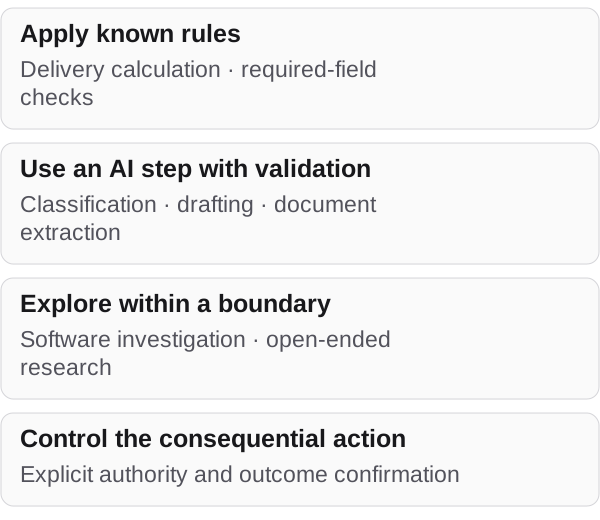
Download the reference table (CSV). The download contains the rows shown above, with their scope and review date. It does not contain campaign results or a completed assessment of your business.
The agent-versus-workflow cost calculator provides a separate economic comparison after the required control structure is understood.
Evidence and scope
- As-of date
- September 14, 2026. Sources reviewed for this article; the editorial allocation is September 13, 2026.
- Method
- Eight original task examples classified using predefined workflow versus dynamic agent control. Categories are editorial recommendations; no deployment outcomes, population estimates or success rates were measured.
- Limits
- Not a universal prescription. Real authority, data sensitivity, reversibility and acceptance tests can change the appropriate design.
06 — Next stepChoose autonomy for a specific reason
Choose autonomy for a specific reason
Use the table to identify where a model needs interpretation and where it needs freedom to choose actions. Keep the rest of the process explicit. The right design is the smallest one that can produce verifiable work under the business’s actual constraints.