When an offer ends, first decide what the page should now do for a visitor. Some pages deserve an updated offer, some retain useful historical information, and some should be removed. A search-removal request cannot make that content decision for you.
This reference follows Google’s page, redirect, removal and promotion documentation, reviewed September 14, 2026. It distinguishes changing the source from changing search visibility. The table is a proposed decision aid for site owners, not a promise that Google will refresh a result immediately.
- 01Fix the source first.An expired price or promise must be addressed on the page and in the systems that reuse it.
- 02Redirect to a relevant replacement.Choose a destination that answers the original visitor’s need.
- 03Temporary hiding is not permanent removal.Search Console tools do not replace a durable source-level change.
01 — Practical guidanceIdentify what actually expired
The offer, the product and the page are different things. A discount may end while the product remains available. An annual event may finish while its programme is still useful. A one-off campaign page may have no continuing purpose. Choose the action based on the remaining content and visitor need.
Check the exact claim causing the problem: a search snippet, a live price, an old call to action or a separate promotion feed. A correct webpage does not prove every distribution channel is current. Record each affected destination before making changes.
For an illustrative seasonal sale, the product page may continue at the standard price while the campaign banner and promotion entry expire. Removing the product page because the discount ended would solve the wrong problem. The example is a decision pattern, not a diagnosis of an account.
02 — Practical guidanceChoose among six page situations
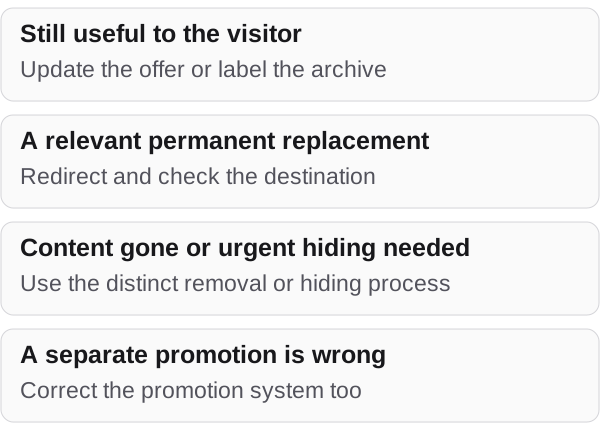
Use the table to specify the intended visitor experience before selecting a technical response. A useful archive should clearly say the offer has ended. A replacement should answer a substantially related need rather than merely being another page on the same website.
Google treats permanent redirects as a signal favouring the target URL, while error responses communicate unavailable content. Those mechanisms are different from updating a page that should remain available.
| Situation | Proposed action | Verification |
|---|---|---|
| Same product, ended discount | Keep the page; update the current offer | Price, dates, structured data and checkout agree. |
| Recurring offer with continuing usefulness | Maintain a clear current page or labelled archive | Expired terms cannot be mistaken for a live promise. |
| Relevant permanent replacement | Use an appropriate permanent redirect | Destination answers the original need without a loop. |
| No remaining content or replacement | Remove with a genuine 404 or 410 response | Do not return a success code for an empty error page. |
| Urgent search hiding needed | Use eligible Search Console removal plus durable source action | Temporary hiding is not the whole removal plan. |
| Website fixed but a promotion remains wrong | Correct the relevant promotion system separately | Feed or promotion status matches the current offer. |
03 — Practical guidanceKeep redirects and removals meaningful
Google’s redirect documentation identifies 301 and 308 as permanent server-side redirects. Use a permanent response when the move is intended to persist. A temporary interruption needs a different decision from a permanently replaced campaign.
Do not send every retired offer to the homepage merely to avoid an error response. A visitor following a specific promise needs a relevant answer or a clear explanation that it is unavailable. Test the entire redirect path and update internal links to the intended destination.
Google’s HTTP status guidance explains how its crawlers interpret error responses. For content that is truly gone, return the appropriate status. A branded explanation can help people, but its HTTP response must still reflect the page state.
04 — Practical guidanceUse search tools for their actual purpose
The Search Console Removals tool can temporarily hide eligible content from Google results. Permanent removal requires a durable action at the source, such as removing the content or using supported indexing controls. A temporary request does not delete the page from the internet.
Google’s Refresh Outdated Content tool serves a different situation: changed or removed content on pages you do not own. Site owners should use the appropriate Search Console controls. It is not a way to remove unchanged current content simply because someone dislikes it.
For an ordinary corrected offer, verify the live page and use the appropriate inspection workflow. Search refresh timing is not guaranteed here. Record what changed and when so a later reviewer can distinguish a stale result from a source that is still wrong.
05 — Practical guidanceCheck promotions and linked claims separately
Google Merchant Center says expired promotions are no longer visible and cannot be reactivated. If a new promotion is needed, follow the current creation rules rather than assuming the old entry can be extended after expiry. That product status is separate from a normal webpage’s indexability.
Check the page title, description, visible offer, structured data, internal banners and scheduled content. A stale promise in any one of those places can keep generating confusion. The technical SEO audit guide can support the implementation review.
For SEO maintenance, retain a short decision record with the old URL, chosen action, replacement if any and verification date. When content has earned useful links, make the visitor transition understandable without promising a particular ranking result.
Choose the continuing purpose of the URL
Download the reference table (CSV). The download contains the rows shown above, with their scope and review date. It does not contain campaign results or a completed assessment of your business.
The canonicalisation guide explains preferred-version signals, while the PDF and HTML publishing guide covers maintaining dated editions. Neither replaces correcting an expired offer at its source.
Evidence and scope
- As-of date
- September 14, 2026. Sources reviewed for this article; the editorial allocation is September 14, 2026.
- Method
- Reviewed Google’s redirect, HTTP status, removal and promotion guidance. Built six content-state decisions and a source-verification checklist; no live URLs or search records were changed.
- Sources
- Google redirects; Google HTTP statuses; Search Console removals; Outdated content refresh; Merchant Center promotion status.
- Limits
- Search refresh is asynchronous. Temporary hiding is not permanent deletion, and no redirect, removal or update guarantees a ranking outcome.
06 — Next stepMake the page state match the offer state
Make the page state match the offer state
Choose the continuing purpose of the URL, implement the corresponding update, redirect or removal, and check every place that repeats the offer. Use search tools to support that durable change and verify the actual visitor experience.