You can reuse the same music across TikTok, Reels, YouTube and ads only when the rights cover those uses. A song appearing in an app’s music picker is not permission to download the finished video and promote it everywhere. The source of the track and the destination of the video both matter.
This reference reviews platform guidance and terms as of September 14, 2026. It separates documented permissions from rights that still need confirmation. It is a publication decision aid, not legal clearance for a particular recording, territory or campaign.
- 01Platform access is not a portable licence.TikTok’s commercial terms restrict off-platform use unless separate rights are obtained.
- 02Business and personal use differ.A track available to a personal account may not be cleared for branded content or ads.
- 03Keep evidence with the asset.Record the track, licence, destination, territory, term and attribution before a video is published.
01 — Practical guidanceStart with the source of the soundtrack
A commercial video may contain several rights-bearing elements: a recording, an underlying composition and material captured incidentally in the footage. The publishing decision needs evidence for the actual audio used. Replacing a track title in a spreadsheet does not change the music embedded in an exported file.
TikTok’s Commercial Music Library terms explicitly say off-platform commercial uses require separate permission from the relevant rights holders. The terms also direct users of the web library to the track’s usable placements. A download or sharing function is not a blanket licence for a new advertising placement.
Meta’s music guidelines make users responsible for appropriate licensing of commercial or non-personal use. They also describe possible muting, blocking or removal where use is unauthorised. These are platform terms, not a promise that every rights dispute will follow the same process.
02 — Practical guidanceCompare the permission, not the library name
The table records what the reviewed sources support and what they do not establish. “Check separately” is an evidence gap, not a conclusion that the use is always forbidden. A direct licence may cover a placement that an in-app library does not.
The Instagram music help page distinguishes its personal, non-commercial licensed library from Sound Collection, which it describes as available for commercial purposes such as ads. The distinction should survive any workflow that automatically repurposes a Reel.
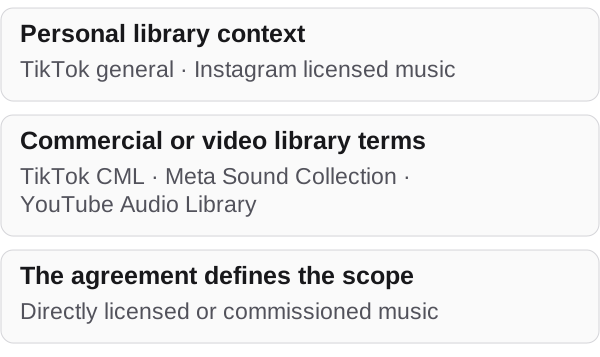
| Audio source | Documented starting point | Before reusing elsewhere |
|---|---|---|
| TikTok general library | Not the commercial library for business activity | Obtain rights appropriate to commercial use. |
| TikTok Commercial Music Library | Commercial TikTok uses subject to terms and track placements | Separate off-platform permission; check usable placements. |
| Instagram licensed music library | Intended for personal, non-commercial use | Do not infer branded or paid-ad clearance. |
| Meta Sound Collection | Instagram help supports commercial use such as ads | Check the actual terms for each other destination. |
| YouTube Audio Library | Video use; attribution depends on the track licence | Inspect the track licence rather than assuming portability. |
| Directly licensed or commissioned music | Scope comes from the actual agreement | Confirm recording, composition, paid placements and duration. |
03 — Practical guidanceYouTube has more than one attribution condition
YouTube’s Audio Library guidance explains that some tracks require Creative Commons attribution while its standard Audio Library licence can be filtered for tracks without that requirement. It also warns that YouTube cannot resolve off-platform legal questions. “Royalty-free” is therefore an incomplete description of the evidence needed.
For a track actually licensed under CC BY 4.0, the licence permits commercial sharing and adaptation subject to its conditions, including appropriate credit and indicating changes. That does not make every track labelled free equivalent, or eliminate other rights that may apply.
Save the exact licence attached to the selected recording. Do not substitute the terms of a different track, a different Creative Commons licence or a later library listing. Where a client supplies audio, ask for the permission record instead of treating possession of the file as proof.
04 — Practical guidanceUse a rights record that survives repurposing
Create one record per soundtrack version. Include the track identifier, source, rights holder or licensor, permitted platforms, organic and paid use, territory, start and end dates, attribution text and the evidence file. The purpose is to make the next publishing decision inspectable without repeating the whole investigation.
In an illustrative campaign, a team may have a TikTok-cleared soundtrack but need a separately licensed recording for Instagram ads and the website. Keep a clean video master without platform music so that changing the soundtrack does not require rebuilding every visual edit. This is a production recommendation, not a statement that one licence must always cover every destination.
If an AI publishing agent chooses music, constrain it to an approved catalogue with the rights fields attached. Require a review when a destination or paid/organic status changes. Our AI creative licensing guide addresses the separate permissions behind generated visual assets.
05 — Practical guidanceReview the final export and the next use
Before publication, check the actual exported file, not only the project timeline. Confirm that temporary music, incidental background audio and old soundtrack versions are absent where they were not cleared. Verify that required credit appears in the destination’s relevant description or other permitted location.
Boosting an existing post deserves another check because the use may change from ordinary publication to advertising. A licence renewal, territory expansion or client handover can also change the decision. Record these changes rather than assuming that a once-approved asset remains suitable indefinitely.
A content production workflow should therefore include a permission check alongside creative and factual review. No automated detector can replace the licence record. When a term is unclear, resolve that specific permission before spending money to distribute the video.
The licence travels only as far as its terms
Download the reference table (CSV). The download contains the rows shown above, with their scope and review date. It does not contain campaign results or a completed assessment of your business.
For adjacent production decisions, see the short-form video guide and the AI creative review framework.
Evidence and scope
- As-of date
- September 14, 2026. Sources reviewed for this article; the editorial allocation is September 13, 2026.
- Method
- Six source categories compared against platform guidance and licence terms. The matrix separates supported uses from unverified destination rights; no individual track was cleared.
- Sources
- TikTok commercial music terms; Meta music guidelines; Instagram music help; YouTube Audio Library; CC BY 4.0.
- Limits
- Track, region and agreement terms can differ. No general legal advice, blanket off-platform permission or claim that AI-generated music is automatically cleared.
06 — Next stepApprove the destination as well as the track
Approve the destination as well as the track
Keep the rights evidence attached to the soundtrack and check it whenever a video changes destination, territory or commercial use. A reusable clean master and a clear licence record prevent a convenient export from becoming an unsupported publishing decision.