The best social advertising platform depends partly on what you know about the buyer. A search query, a job role and a related conversation can all be useful signals. None, by itself, proves that a person is ready to purchase. Choose a platform test around the evidence your offer needs.
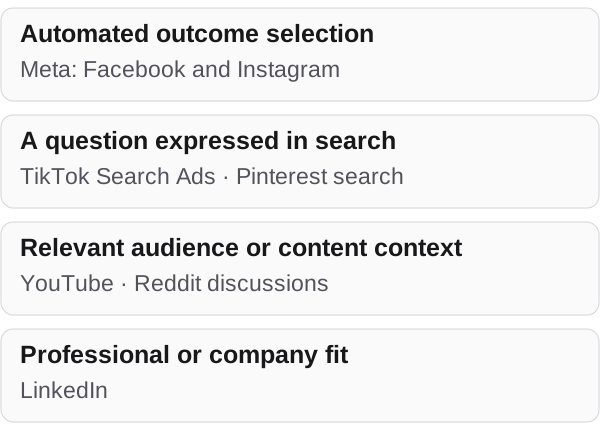
This reference compares documented targeting approaches across Meta, TikTok, YouTube, LinkedIn, Reddit and Pinterest as of September 14, 2026. Facebook and Instagram are grouped under Meta because the advertising system is shared. The table compares signal meaning, not platform popularity, audience quality or guaranteed returns.
- 01Name the signal.An explicit query, professional attribute and content context are different reasons to consider an audience.
- 02Check delivery constraints.A targeting input may guide automation without defining an exclusive audience.
- 03Measure commercial relevance.Validate suitable customers after the click, rather than treating targeting precision as proof of demand.
01 — Practical guidanceStart with what makes a customer suitable
Write down the condition that matters for the offer. A business service may require a particular organisational role. A specialist product may need an explanation of how it solves a task. A time-sensitive service may need customers actively seeking help. Those differences should shape the first experiment.
Then distinguish known facts from inferred interest. A person watching related content could be researching a purchase, studying the topic or simply enjoying it. A professional attribute can help establish relevance while saying little about authority, timing or available budget.
Do not construct a ranking by mixing platform case studies with incompatible outcomes. A reported click-through improvement and a qualified sales opportunity are different units. The table below deliberately omits performance scores because the reviewed sources do not provide a comparable cross-platform experiment.
02 — Practical guidanceCompare the meaning of six targeting approaches
Read each row as a starting point for campaign design. Available settings vary with objective, format, market and account. A useful comparison records those conditions and the expansion behaviour actually enabled, rather than assuming every feature on a help page is available everywhere.
The final column is an editorial limitation, not a claim that the signal has no value. It identifies the additional evidence needed before a targeting choice becomes a business recommendation.
| Advertising environment | Documented approach | Useful question | What it does not prove |
|---|---|---|---|
| Meta: Facebook and Instagram | Advantage+ sales combines audience, placement and budget automation | Can the selected strategy find suitable outcomes? | That every person reached explicitly searched for the offer. |
| TikTok Search Ads | Keywords managed at ad-group level in search results | Which customer questions can the ad answer? | That a Google keyword has the same performance here. |
| YouTube through Google Ads | Audience segments; eligible content targeting by format and campaign | Is audience interest or viewing context relevant? | That a content keyword is the current search query. |
| Professional demographics, firmographics and matched audiences | Does the audience fit the business role or organisation? | That the person controls budget or is buying now. | |
| Keywords for contextually relevant discussions | Where is the problem being discussed? | That discussion participation implies purchase readiness. | |
| Interests, search keywords, audiences and placements | Can the offer help with a searched or planned idea? | That inspiration will convert within your chosen window. |
03 — Practical guidanceRead automation and context carefully
Meta’s Advantage+ sales documentation describes audience, placement and budget automation together. Pinterest’s targeting overview describes Performance+ reaching related interests or keywords. Record the actual controls and expansion settings before calling a campaign narrowly targeted.
Google’s video targeting documentation distinguishes audience and content methods, with restrictions for conversion-focused video campaigns. A keyword describing video content is not equivalent to a query entered in a search engine. Keep that distinction visible in a planning spreadsheet.
TikTok Search Ads offers a specific search-results context. That can support a question-led creative brief, but it still leaves the task of demonstrating relevance and measuring outcomes. Our keyword transfer guide explains what needs rechecking.
04 — Practical guidanceUse professional and community signals for the right job
LinkedIn’s audience documentation supports professional and company-based targeting approaches. For a specialist service, that can help define an eligible audience. The creative still needs to explain why the problem matters and what a sensible next step looks like.
Reddit’s keyword targeting page describes placing ads in relevant discussion contexts. A useful message should answer the problem being discussed and make its commercial purpose clear. The existence of a conversation is not evidence that everyone involved wants a sales approach.
Pinterest’s search and discovery surfaces can support different stages of planning. Separate the selected placement from the interest or keyword input. If the buying cycle is long, retain an outcome window that can observe the relevant behaviour instead of judging the channel solely on immediate purchases.
05 — Practical guidanceChoose a small, interpretable comparison
Select two plausible strategies that answer the same business objective. Give each a suitable creative and destination, and define the outcome consistently. A business-service enquiry should meet the same qualification rule regardless of whether it began on LinkedIn, YouTube or Instagram.
Record configuration, creative costs, attribution settings and follow-up quality. A channel that produces cheap forms but consumes disproportionate sales time may not be the better investment. Conversely, a slower conversion cycle needs enough observation before you can interpret its apparent cost.
For paid-media planning, use this matrix to justify what to test first. Keep the result provisional and local to the offer. Our Facebook versus Instagram test guide shows how that principle applies within one advertising system.
Choose the signal your first test needs
Download the reference table (CSV). The download contains the rows shown above, with their scope and review date. It does not contain campaign results or a completed assessment of your business.
Use the video metric reference before comparing attention, and the incrementality guide before interpreting credited conversions as additional sales.
Evidence and scope
- As-of date
- September 14, 2026. Sources reviewed for this article; the editorial allocation is September 14, 2026.
- Method
- Compared six primary platform documentation sets by signal, context and decision limitation. The matrix is an editorial taxonomy, not a performance benchmark or complete feature inventory.
- Sources
- Meta sales campaigns; TikTok Search Ads; Google video targeting; LinkedIn audiences; Reddit keywords; Pinterest targeting.
- Limits
- Objectives, markets, account eligibility and expansion settings affect availability. Signal relevance does not establish individual intent, permission to use data or superior ROI.
06 — Next stepChoose a signal, then test the business result
Choose a signal, then test the business result
Start where the targeting approach fits what makes a customer suitable. Document the actual delivery conditions and measure outcomes consistently. A defensible platform choice grows from that evidence, rather than from a universal social-media ranking.