Professional editing can change how an AI detector scores a document. That does not mean an editor changed who wrote it. A new preprint makes this a timely issue for publishers and content teams: a detector flag needs context before it becomes a judgment about a writer.
The practical response is to preserve evidence about how the work was produced and review the actual content. This article distinguishes a research finding from a proposed editorial process. The checklist below is our guidance; it is not a detection system validated by the study.
- 01Editing can affect scores.The reported direction varies by detector; polishing does not always increase a flag.
- 02The study has a defined scope.Public detectors and service-submitted documents do not represent every commercial tool or genre.
- 03Review evidence before making an accusation.Use version history, sources and the declared workflow alongside any detector result.
01 — Practical guidanceWhat the new paper does and does not establish
The August 27, 2026 preprint, Style as a Confound, evaluates 135,389 original–edited document pairs from 2018–2025 with 13 publicly available detectors. Editing raises some scores and lowers others. The corpus consists of submissions by non-native English speakers, professionally edited by native-speaker editors. It includes several service categories, not only journal articles.
Its protocol permits supplementary AI grammar checking for mechanical errors, while prohibiting generated rewriting. The pre-ChatGPT subset provides stronger authorship provenance than later submissions. Proprietary commercial detectors and matched AI-generated controls are outside the evaluation. These limits prevent a universal false-positive estimate or a ranking of current commercial products.
The useful inference for an editor is narrower: do not treat a stylistic score as a complete record of authorship. The paper is a preprint, and this article does not independently reproduce its experiments. Its findings should prompt a better review process, not a new automatic rule.
02 — Practical guidanceUse five questions to review an authorship concern
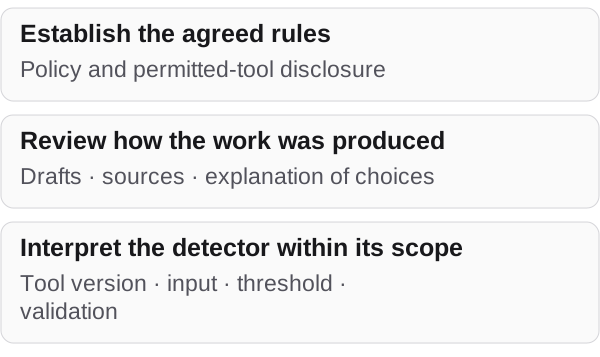
The table below is an editorial evidence checklist. It does not assign weights or produce an authenticity percentage. Each item answers a different question, and missing evidence should remain missing rather than being converted into presumed misconduct.
Apply the same process consistently. A fluent writer, a non-native writer and a writer who uses permitted proofreading assistance should all know the rules before submitting work. The outcome should distinguish a quality problem, an unclear disclosure and a supported policy breach.
| Evidence question | Useful material | Limit to retain |
|---|---|---|
| What was the agreed policy? | Brief and permitted-tool disclosure | A rule introduced after submission is not the original agreement. |
| How did the document develop? | Drafts, notes and version history voluntarily supplied | A single saved file does not establish the full process. |
| Are the claims supported? | Sources, calculations and attributable quotations | Accurate facts alone do not identify the authoring tool. |
| Can the writer explain the work? | Discussion of choices and substantive revisions | Confidence or language fluency is not proof of authorship. |
| What does the detector output mean? | Tool version, input length, threshold and validation scope | A score alone does not prove misconduct. |
03 — Practical guidanceKeep content quality separate from tool use
A document can be human-written and inaccurate. It can also involve disclosed AI assistance while meeting an organisation’s quality policy. Assess factual support, originality, attribution and usefulness directly. Do not let a reassuring detector result substitute for reading the article.
For a content team, define what assistance is allowed: brainstorming, spelling correction, translation, research support or drafting may need different disclosures. The policy should say who accepts responsibility for sources and final claims. Avoid the vague requirement that work must merely “pass an AI test”.
Our original research publication checklist provides a complementary method for checking evidence. It asks whether somebody can understand and reuse a claim, regardless of which tools helped prepare the prose.
04 — Practical guidanceHandle a flag without forcing a rewrite contest
Preserve the submitted version and the exact detector result if the organisation uses one. Record the relevant configuration and what text was included. A score without the input, tool identity or threshold is difficult to interpret and harder to revisit fairly.
Invite a factual explanation of the workflow and relevant supporting material. Do not demand unrelated private documents or assume that a writer with fewer saved drafts is dishonest. A reviewer can identify an unresolved concern without presenting it as a proven breach.
Repeatedly rewriting until a detector produces a preferred number is a poor quality target. It can remove precise terminology, damage citations and reward stylistic tricks. Ask instead for revisions that improve clarity, evidence and relevance. Compare the revised work with the actual brief.
05 — Practical guidancePublish an accountable editorial decision
Record which policy applied, which evidence was reviewed and why the final action follows. If the problem is an unsupported claim, correct the claim. If the problem is missing disclosure, resolve the disclosure under the agreed rules. If authorship remains uncertain, preserve that uncertainty in the internal decision.
The AI benchmark evidence reference explains why measured performance needs a clear evaluation context. Apply that same caution when selecting a detector: ask what language, genre, length and tool versions its validation represents before adopting a threshold.
For content marketing, trust comes from work readers can inspect: useful answers, reliable sources and clear responsibility. A detector can at most contribute a scoped signal to the process. It should not become the definition of quality.
Build an editorial judgment from evidence
Download the reference table (CSV). The download contains the rows shown above, with their scope and review date. It does not contain campaign results or a completed assessment of your business.
For teams assigning more of the workflow to software, the agent-versus-workflow decision table helps identify which judgments still need explicit human acceptance.
Evidence and scope
- As-of date
- September 14, 2026. Sources reviewed for this article; the editorial allocation is September 14, 2026.
- Method
- Read the full August 27 preprint and its methods and limitations. Built a separate five-question editorial checklist. No detector execution, commercial-tool ranking or reproduced experiment.
- Sources
- Style as a Confound preprint.
- Limits
- Preprint evidence; mixed editing-service categories; permitted mechanical grammar assistance; no matched generated controls. Detector-specific false-positive percentages are not generalised.
06 — Next stepReview the work and the evidence behind it
Review the work and the evidence behind it
A detector flag is a reason to ask a well-defined question, not a complete answer about authorship. Set the policy beforehand, examine the sources and production record, and make an editorial decision that the evidence can support.